Reachability Games with Relaxed Energy Constraints


Ritam Raha


joint work with

Nicolas Markey                              Loïc Hélouët

INRIA Rennes                               INRIA Rennes


1

Games on Graphs: Qualitative/Quantitative
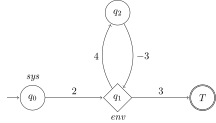

  • Two players on a graph: typically system ($P_1$) and environment ($P_2$)
  • Qualitative objectives: Reachability, Safety, Büchi
  • Quantitative objectives: Energy, Mean-payoff, Discounted

2

Energy with Reachability


  • Weights are intergers; w.l.o.g we start with $0$.

Objective: $P_1$ has to reach T maintaining energy level within some given bounds

3

Different Settings: Strong vs Weak Bounds


L = 0 energy level = 0 (Strong) Lower Bound Game: L = 0 energy level=2 (Strong) Lower Bound Game: L = 0 energy level=6 (Strong) Lower Bound Game: L = 0 energy level=3 (Strong) Lower Bound Game: L = 0 energy level=6 (Strong) Lower Bound Game:✔ L = 0, U=4 energy level= (Strong) Lower Bound Game:✔ (Strong) Dual Bound Game: L = 0, U=4 energy level=2 (Strong) Lower Bound Game:✔ (Strong) Dual Bound Game: L = 0, U=4 energy level=2 (Strong) Lower Bound Game:✔ (Strong) Dual Bound Game: ✘ L = 0, W = 4 energy level=2 (Strong) Lower Bound Game:✔ (Strong) Dual Bound Game: ✘ (Weak) Dual Bound Game: L = 0, W = 4 energy level=4 (Strong) Lower Bound Game:✔ (Strong) Dual Bound Game: ✘ (Weak) Dual Bound Game: L = 0, W = 4 energy level=1 (Strong) Lower Bound Game:✔ (Strong) Dual Bound Game: ✘ (Weak) Dual Bound Game: L = 0, W = 4 energy level=4 (Strong) Lower Bound Game:✔ (Strong) Dual Bound Game: ✘ (Weak) Dual Bound Game: ✔ L = 0, U = 4, v = 1 energy level= (Strong) Lower Bound Game:✔ (Strong) Dual Bound Game: ✘ (Weak) Dual Bound Game: ✔ Bounded Violation Game: L = 0, U = 4, v = 1 energy level= (Strong) Lower Bound Game:✔ (Strong) Dual Bound Game: ✘ (Weak) Dual Bound Game: ✔ Bounded Violation Game: ✔ L = 0, U = 4, v = 0 energy level= (Strong) Lower Bound Game:✔ (Strong) Dual Bound Game: ✘ (Weak) Dual Bound Game: ✔ Bounded Violation Game: ✘ L = 0, U = 4, v = 0 energy level= (Strong) Lower Bound Game:✔ (Strong) Dual Bound Game: ✘ (Weak) Dual Bound Game: ✔ Bounded Violation Game: ✘ L = 0, U = 4, v = 0 energy level= (Strong) Lower Bound Game:✔ (Strong) Dual Bound Game: ✘ (Weak) Dual Bound Game: ✔ Bounded Violation Game: ✘

4

Strong Lower Bound Games


$P_1$ maintains energy level $\geq L$ & reach $T$

Classical Setting: Infinite path setting without reachability

  • 1-player L-infinite games are in P and 2-player are in NP $\cap$ coNP

  • Idea:
    • $P_1$ finds a non-negative cycle and repeat
    • memoryless strategies for both players

5

Reductions


Reachability Game Reachability Game Infinite Game Reachability Game Infinite Game ⟹ Reachability Game Infinite Game ⟹ Reachability Game Infinite Game ⟹ Reachability Game Infinite Game ⟹ Reachability Game Infinite Game ⟸ Reachability Game Infinite Game ⟸ Reachability Game Infinite Game ⟸ Reachability Game Infinite Game ⟺
  • With reachability: Same complexity
  • 6

    Strong Dual Bound Games


    $P_1$ maintains $L \leq$ energy level $\leq U$ & reach $T$

    • One player game: PSPACE-complete (reduction from Reachability of bounded one counter automaton )

    • Two player game: EXPTIME-complete (reduction from Countdown Games )

    With strong bounds, reachability and infinite Games are interreducible!

    7

    Weak Dual Bound Games


    Relax one of the bounds, say the upper bound

    - $P_1$ has to maintain energy level $\geq L$ & reach $T$
    but
    the upper bound $W$ ($U$) is weak,
    i.e.,
    if energy hits $\geq W$, it stays at $W$.

    8

    Motivation towards Weak Bounds

    Access Secret Access Secret Access Secret Access Secret Access Secret +10 +6 +5 Access Secret +10 +6 +5 -2 -20 -4 Access Secret +10 +6 +5 -2 -20 -4
    Can be formulated as a two player finite state game. [Hélouët et al.'18]

    - An intruder takes a large number of normal actions and then does somethings bad. ✕
    - With weak upper bound, this is not possible. ✔

    8

    Infinite vs Reachability in Weak Dual Bound Games


    L = 0, W = 4 energy level = 0 Infinite Setting L = 0, W = 4 energy level=1 Infinite Setting L = 0, W = 4 energy level = 0 Infinite Setting L = 0, W = 4 energy level=4 Infinite Setting L = 0, W = 4 energy level=2 Infinite Setting L = 0, W = 4 energy level=2 Infinite Setting L = 0, W = 4 energy level=2 Infinite Setting Conceptually easy: find a cycle that can be iterated once with a positive effect; memoryless strategy for both players L = 0, W = 4 energy level=2 Reachability Setting L = 0, W = 4 energy level=2 Reachability Setting L = 0, W = 4 energy level = 0 Reachability Setting L = 0, W = 4 energy level=4 Reachability Setting L = 0, W = 4 energy level=3 Reachability Setting L = 0, W = 4 energy level=3 Reachability Setting L = 0, W = 4 energy level = 0 Reachability Setting L = 0, W = 4 energy level=4 Reachability Setting L = 0, W = 4 energy level=4 Reachability Setting L = 0, W = 4 energy level=4 Reachability Setting L = 0, W = 4 energy level = 0 Reachability Setting 😃 !! L = 0, W = 4 energy level = 0 Reachability Setting 😃 !! Keep track of the exact energy level; exponential memory for P1.

    9

    Memory for $P_2$

    λ λ >5 >7 λ >5 >7 >max{5-(-1),7-2} λ >5 >7 >6 λ=winning >5 >7 >6 λ=winning >5 >7 <6 λ=winning >5 >7 <6 λ=winning >5 >7 <6 P2 has memoryless winning strategy!!

    10

    1 Player Game


    • Consider a winning strategy $\sigma$ of $P_1$.

    • Any outcome of $\sigma$ will not have any zero cycle or negative cycle.

    • Now, $P_1$ has two options:
      - win in an acyclic path
      - choose a positive cycle; iterate enough to increase energy; continue

    11

    Technical Observations


    • Same cycle can be positive or negative cycle depending on the initial energy level.
    $W = 4$.
    • $x=4 \Rightarrow$ a negative cycle
    • $x=1 \Rightarrow$ a positive cycle

    • A feasible positive cycle can be iterated and the output energy stabilizes.
      Why?

    12

    Positive Cycle


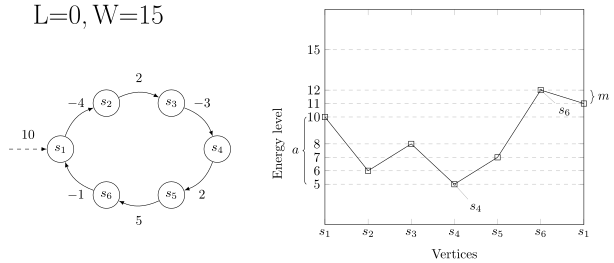
    - Reach $s_1$ with energy $\geq 5 (L+a)$ and reach energy level $14 [W-m]$
    - #Iterations can be bounded by W-L.

    13

    Winning Path

    energy level = 0 q1 0 energy level=6 q1 0 q2 6 energy level = 0 q1 0 q2 6 q1 2 q3 1 q4 4 q3 2 q5 4 q3 3 q4 6 q3 4 q1 6 T 0 energy level = 0 q1 0 q2 6 q1 2 q3 1 q4 4 q3 2 q5 4 q3 3 q4 6 q3 4 q1 6 T 0 ► Ignore cycles of size |Q|, check smaller ones energy level = 0 q1 0 q2 6 q1 2 q3 1 q4 4 q3 2 q5 4 q3 3 q4 6 q3 4 q1 6 T 0 ► Ignore cycles of size |Q|, check smaller ones energy level = 0 q1 0 q2 6 q1 2 q3 1 q4 4 q3 2 q5 4 q3 3 q4 6 q3 4 q1 6 T 0 ► Ignore cycles of size |Q|, check smaller ones energy level = 0 q1 0 q2 6 q1 2 q3 1 q4 4 q3 2 q5 4 q3 3 q4 6 q3 4 q1 6 T 0 ► Ignore cycles of size |Q|, check smaller ones ► Ignore same cycles, iterate enough at the first occurrence energy level=2 q1 0 q2 6 q1 2 q3 1 q4 4 q3 2 q5 4 q3 3 q4 6 q3 4 q1 6 T 0 ► Ignore cycles of size |Q|, check smaller ones ► Ignore same cycles, iterate enough at the first occurrence energy level=4 (rotating the cycle 2 times) q1 0 q2 6 q1 2 q3 1 q4 4 q3 2 q5 4 q3 3 q4 6 q3 4 q1 6 T 0 ► Ignore cycles of size |Q|, check smaller ones ► Ignore same cycles, iterate enough at the first occurrence energy level=4 (rotating the cycle 2 times) q1 0 q2 6 q1 2 q3 1 q4 4 q3 2 q5 4 q3 3 q4 6 q3 4 q1 6 T 0 ► Ignore cycles of size |Q|, check smaller ones ► Ignore same cycles, iterate enough at the first occurrence ► Winning Path: α1 · ϕ1n ··· αk · ϕkn, n =W-L

    14

    Universal Cycle


    Universal cycle on $q$: a cycle that can be taken with initial energy $L$. L = 0, W = 4 L = 0, W = 4 L = 0, W = 4 abcde ✘ universal L = 0, W = 4 abcde ✘ universal bcdea ✔ universal (Output= 2) L = 0, W = 4 abcde ✘ universal bcdea ✔ universal (Output= 2) L = 0, W = 4 abcde ✘ universal bcdea ✔ universal (Output= 2) bde ✔ universal (Output= 1) L = 0, W = 4 abcde ✘ universal bcdea ✔ universal (Output= 2) bde ✔ universal (Output= 1) bcdea ▻ bde L = 0, W = 4 abcde ✘ universal bcdea ✔ universal (Output= 2) bde ✔ universal (Output= 1) bcdea ▻ bde Find Optimal Universal Cycles!

    15

    NP algorithm for 1 Player Game


    • For every cycle, there is a universal cycle.

    • Winning paths: $\beta_1 \cdot {\tau_1}^{W-L} \cdot\beta_2\cdot{\tau_2}^{W-L} \cdots \beta_k \cdot {\tau_k}^{W-L}$ where, $\tau_j$'s are universal.

    • Use optimal universal cycles: $k<|Q| \Rightarrow$ NP Algorithm!!

    • Cycles(EXPTIME) $\Rightarrow$ Universal Cycles(EXPTIME) $\Rightarrow$ Optimal UC(NP) $\Rightarrow$ P ?

    • Idea for P:
      • Find Optimal UC in P
      • Find the winning path in P

    16

    Road to P: DAG-construction


    energy level = 0 q3 q4 q5 q1 T q3 q3 q2 q3 q1 T q3 energy level = 0 M=maximal energy seen m=M-current energy q3 q4 q5 q1 T q3 q3 q2 q3 q1 T q3 energy level=3 M=maximal energy seen m=M-current energy q3 q4 q5 q1 T q3 q3 q2 q3 q1 T q3 (0,0) (3,0) energy level=1 M=maximal energy seen m=M-current energy q3 q4 q5 q1 T q3 q3 q2 q3 q1 T q3 (0,0) (3,0) (3,2) energy level=2 M=maximal energy seen m=M-current energy q3 q4 q5 q1 T q3 q3 q2 q3 q1 T q3 (0,0) (3,0) (3,2) (2,0) (2,1) (2,0) (2,1) (6,0) (6,4) (6,5) ✘ ✘ M=maximal energy seen m=M-current energy q3 q4 q5 q1 T q3 q3 q2 q3 q1 T q3 (0,0) (3,0) (3,2) (2,0) (2,1) (2,0) (2,1) (6,0) (6,4) (6,5) ✘ ✘ ► If a cycle ends with (M,m), it finally outputs W-m q3q1q3is one of the optimalUC ! q3 q4 q5 q1 T q3 q3 q2 q3 q1 T q3 (0,0) (3,0) (3,2) (2,0) (2,1) (2,0) (2,1) (6,0) (6,4) (6,5) ✘ ✘ ► If a cycle ends with (M,m), it finally outputs W-m q3q1q3is one of the optimalUC ! But still Exponential!! q3 q4 q5 q1 T q3 q3 q2 q3 q1 T q3 (0,0) (3,0) (3,2) (2,0) (2,1) (2,0) (2,1) (6,0) (6,4) (6,5) ✘ ✘ ► If a cycle ends with (M,m), it finally outputs W-m q3q1q3is one of the optimalUC ! $(M,m) \prec (M',m'):$ $M − m \leq M' − m'$ and $m' \leq m$. q3 q4 q5 q1 T q3 q3 q2 q3 q1 T q3 (0,0) (3,0) (3,2) (2,0) (2,1) (2,0) (2,1) (6,0) (6,4) (6,5) ✘ ✘ ► If a cycle ends with (M,m), it finally outputs W-m q3q1q3is one of the optimalUC ! $(M,m) \prec (M',m'):$ $M − m \leq M' − m'$ and $m' \leq m$. $\rho \leq \rho' \Rightarrow$ we store only $\rho'$ q3 q4 q5 q1 T q3 q3 q2 q3 q1 T q3 (0,0) (3,0) (3,2) (2,0) (2,1) (2,0) (2,1) (6,0) (6,4) ✘ (6,5) ✘ ✘ ► If a cycle ends with (M,m), it finally outputs W-m q3q1q3is one of the optimalUC ! $(M,m) \prec (M',m'):$ $M − m \leq M' − m'$ and $m' \leq m$. $\rho \leq \rho' \Rightarrow$ we store only $\rho'$ q3 q4 q5 q1 T q3 q3 q2 q3 q1 T q3 (0,0) (3,0) (3,2) (2,0) (2,1) (2,0) (2,1) (6,0) (6,4) ✘ (6,5) ✘ ✘ ► If a cycle ends with (M,m), it finally outputs W-m ► Only store maximal labels: PTIME!!

    17

    Polynomial Algorithm


    • Compute $m_q$ for each state q if it has an optimal universal cycle

    • Construct $G'$ adding transition $\upsilon_q: q \xrightarrow{:=W-m_q} q$.

    • Winning paths: $\beta_1 \cdot \upsilon_1 \cdots \beta_k\cdot \upsilon_k$

    • path size $ \leq (|Q+1|)^2$:
      PTIME!

    Corollary: Two player LW-reachability is in coNP.

    18

    Conclusion


    19